
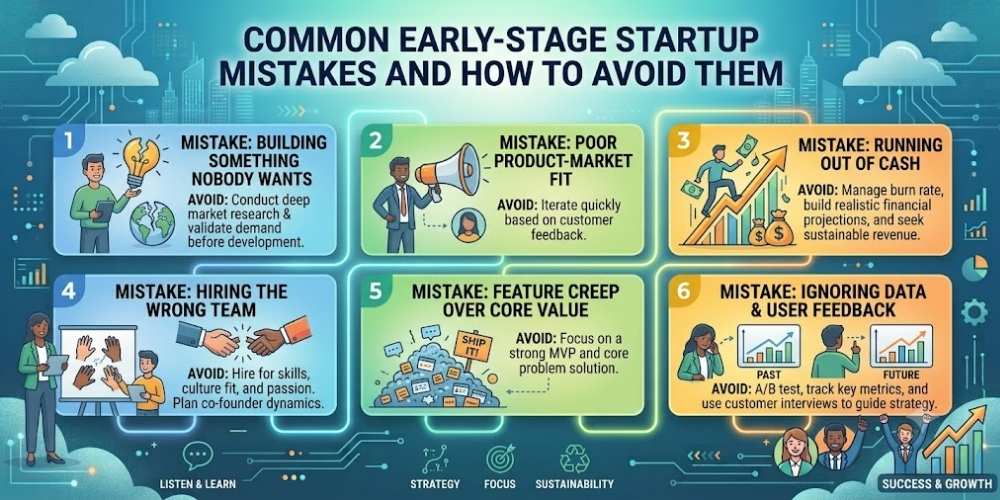
Common Early-Stage Startup Mistakes and How to Avoid Them
Quick summary: Building a company becomes easier when a large ambition is translated into small, testable steps. Early progress usually comes from customer conversations, simple offers, and disciplined learning rather than a perfect plan.
Building a company becomes easier when a large ambition is translated into small, testable steps. Early progress usually comes from customer conversations, simple offers, and disciplined learning rather than a perfect plan.
A founder should focus first on evidence: who has the problem, how urgent it is, what people currently do, and whether they will pay for a better solution.
Start With a Clear Goal
The topic of common early-stage startup mistakes and how to avoid them should begin with a concrete outcome. Write down what success should look like in the next 30 to 90 days. A useful goal is specific enough to guide daily choices and simple enough to explain to a teammate, customer, or advisor.
In practice, the topic of common early-stage startup mistakes and how to avoid them should begin with a concrete outcome. Write down what success should look like in the next 30 to 90 days. A useful goal is specific enough to guide daily choices and simple enough to explain to a teammate, customer, or advisor.
Understand the Current Situation
Before changing tools, processes, pricing, or strategy, review the current baseline. Gather customer feedback, performance data, team observations, and financial constraints. This prevents the business from solving the wrong problem or copying tactics that do not fit its stage.
Before changing tools, processes, pricing, or strategy, review the current baseline. Gather customer feedback, performance data, team observations, and financial constraints. This prevents the business from solving the wrong problem or copying tactics that do not fit its stage.
Create a Small, Testable Plan
Break the goal into a short experiment with a defined owner, deadline, and measurement. Small tests reduce risk and create learning quickly. Document the assumption behind the test so the team can understand why the result matters.
Break the goal into a short experiment with a defined owner, deadline, and measurement. Small tests reduce risk and create learning quickly. Document the assumption behind the test so the team can understand why the result matters.
Build Feedback Into the Process
Progress improves when feedback is collected continuously. Speak with customers, review team friction, and compare expected results with actual outcomes. Keep what works, adjust what is unclear, and stop activities that consume time without creating value.
Progress improves when feedback is collected continuously. Speak with customers, review team friction, and compare expected results with actual outcomes. Keep what works, adjust what is unclear, and stop activities that consume time without creating value.
Turn Learning Into a Repeatable System
Once an approach works, convert it into a checklist, template, dashboard, or standard operating procedure. Repeatable systems make growth less dependent on memory and help new team members contribute faster.
Once an approach works, convert it into a checklist, template, dashboard, or standard operating procedure. Repeatable systems make growth less dependent on memory and help new team members contribute faster.
Key Takeaway
Common Early-Stage Startup Mistakes and How to Avoid Them becomes more manageable when founders define a clear outcome, test one focused approach, review evidence, and turn successful actions into repeatable systems.
Frequently Asked Questions
What is the best first step for common early-stage startup mistakes and how to avoid them?
Start by defining one clear business outcome, reviewing the current situation, and choosing a small action that can produce measurable learning.
How long should a startup test a new strategy?
The test should run long enough to collect meaningful evidence but remain short enough to change direction quickly. Many early-stage experiments can be reviewed within two to six weeks.
What metrics should founders track?
Track a small set of metrics connected to customer value, revenue, retention, cost, quality, or team execution. Avoid measurements that look impressive but do not improve decisions.

Emma Carter is a startup editor and business writer with a passion for entrepreneurship, women founders, SaaS, artificial intelligence, and startup innovation. She covers emerging business trends, funding strategies, leadership, remote work, and practical insights that help entrepreneurs build sustainable and scalable companies. Through research-driven articles and expert analysis, Emma shares valuable knowledge for founders, startups, and business professionals around the world.